Category: amazon

  • Why This Clear Plastic Raincoat Is My New Go-To for Rainy Runs — and the Rest of the Day

    Why This Clear Plastic Raincoat Is My New Go-To for Rainy Runs — and the Rest of the Day

    I’ve never liked rain, but read about why I don’t have to dread rainy runs and walks anymore!

    Kids may not even notice it’s raining, but I do!

    I got a raincoat! Speaking of those small purchases that make a world of difference in your life, this is one of them. I’d never had a raincoat that I liked before now. This new Clear Plastic Raincoat is making all the difference in my attitude towards, and experience during, rainy days. 

    Why I’m Outside on Rainy Days

    I’ve mentioned before that I run even if it’s raining (check out my personal running FAQs if you haven’t already!), and that I don’t have a car (read about how I get around here!). That means I can be outside and get very wet on rainy days. 

    Thankfully, it doesn’t rain much here. I might run in the rain about 10 times a year. Aside from picking up my son from school, I can usually stay inside the rest of the time it’s raining. However, for those times when I do have to run or go outside in the rain, I get wet. I don’t mind it that much, but when I am wet for too long, I get cold, and that makes it hard to run. 

    (In case you’re wondering why I don’t just stay inside on rainy days, I don’t like being inside all day. I feel trapped. I have trouble thinking. Luckily, I’m able to walk in our building’s underground and underused parking lot and stay dry). 

    Bulky Raincoats, Lightweight Ponchos, and Running Jackets Didn’t Work for Me

    It took me years to settle on this plastic raincoat. For almost two decades, I didn’t wear rain gear while running in the rain.  I probably didn’t care much as a middle school and high school student. By college and graduate school, I was in a place with a true winter, and was probably so happy to be running in summer rain instead of winter snow that I didn’t bother worrying about it. 

    A classic rain jacket never did the trick for me. It was too bulky.

    That changed when I came home (to a warm place!) after graduate school. To stay drier, I tried running jackets that were described as waterproof. They weren’t, but I tried for years. 

    Then I started wearing plastic ponchos from dollar stores. They were pretty effective, but had some serious flaws. They are intended to be disposable, meaning they tear easily when putting them on and taking them off. They are loud. They act like a parachute because they’re so big and floppy. And, you can’t adjust them if something goes wrong. The rain just comes in. 

    For the rest of the day, a poncho works, but it has the same problems. It’s hard to manipulate. It’s awkward. And, it doesn’t dry fast, so if you come in from one run or walk and it’s wet, it’s nearly impossible to put it back on within a few hours.

    A bulky raincoat is good for walking around, but it’s a bit of a nuisance. The thought of having to put it on makes me not want to go outside. 

    I needed a solution for running and walking, and for easy use throughout the day. The plastic raincoat was it. 

    Great Features of My Plastic Raincoat 

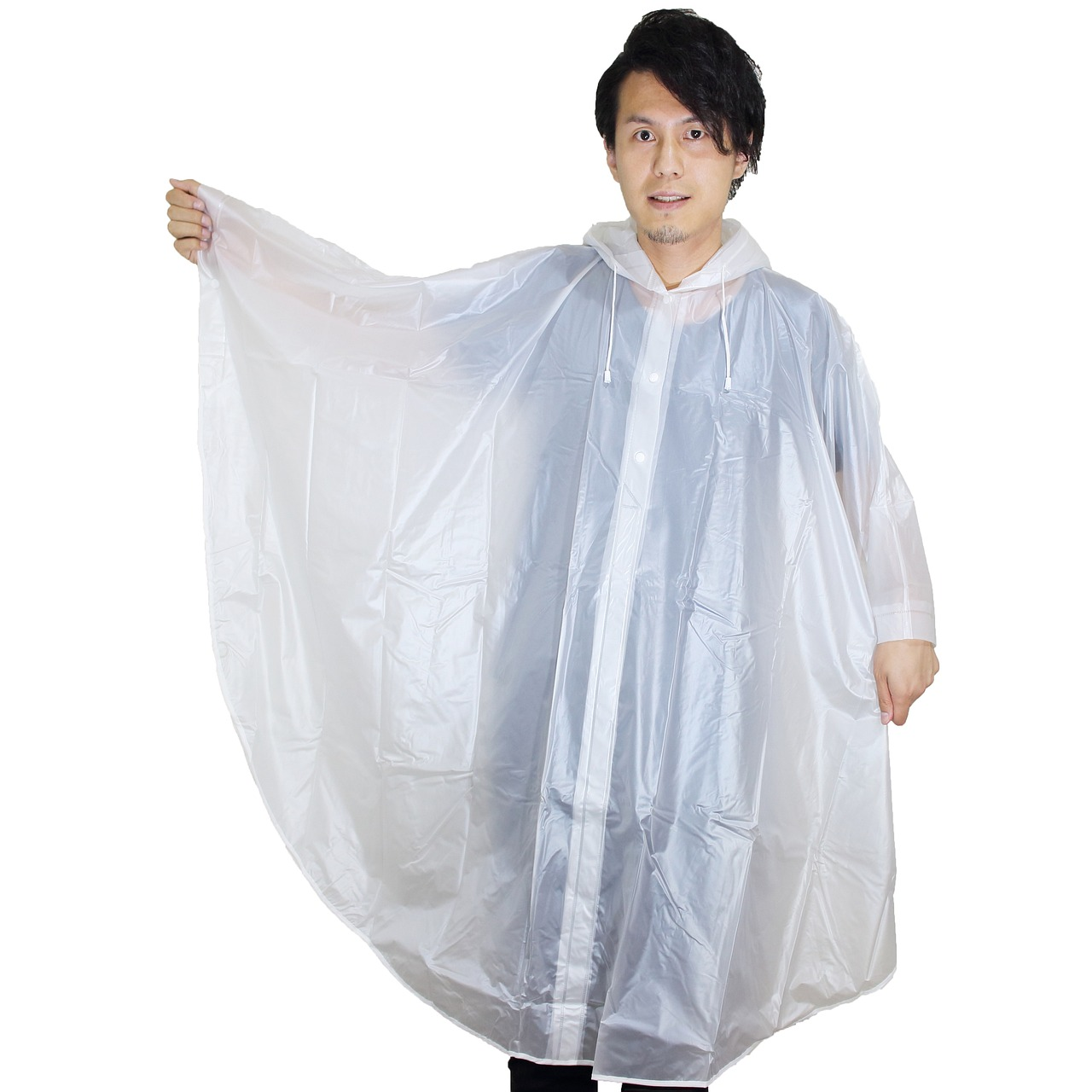
    Here are some features of my raincoat, which I purchased for under $15.

    • It has a detachable hood, which I appreciate because I don’t like running with a hood. I wear a cap or visor to keep rain off of my glasses.
    • I got a medium size because the reviews said to order a size up. That was appropriate for me, and I can wear my normal clothes underneath it.
    • It has nice clear plastic pockets in the front.
    • The sleeves snap at the wrists for good fit and better ability to keep long sleeves dry underneath. 

    It’s super light weight so it doesn’t bother me at all. 

    Keep trying until you find rain gear that works for you. It’s worth it!

    Here are more advantages 

    • The raincoat is easy to put on and take off, even when wet
    • It dries quickly
    • It lets me adjust a bag or shoes without disrupting my whole run or walk
    • It is comfortable and doesn’t flop, drag, or make much noise when I run
    • The sleeves are longer and more protective than in a poncho, so my clothes underneath stay dry even if the rain is heavy.

    Comparison of a Plastic Raincoat, Plastic Poncho, and Heavy-Duty Rain Coat

    Comparison: Plastic Raincoat vs. Plastic Poncho vs. Heavy-Duty Rain Coat
    Feature Plastic Raincoat (clear shell) Plastic Poncho Heavy-Duty Rain Coat
    Waterproofness High — full waterproof shell that keeps most rain out. Variable — lightweight but often gaps at sleeves/neck allow water in. Very high — purpose-built with sealed seams and durable membranes.
    Ease of put on / take off Easy — conventional coat shape makes dressing and undressing simple, even when wet. Can be awkward once wet — large loose shape is harder to manage on/off. Moderate — engineered closures, but heavier and bulkier to remove/store.
    Packability Very good — lightweight and folds compactly for a bag or pocket. Excellent — typically folds very small (thin plastic). Poor to moderate — bulkier; may compress into a stuff-sack but takes room.
    Breathability Poor to moderate — non-breathable plastic can trap heat and moisture inside. Poor — thin plastic traps heat and can lead to clamminess. Good — often uses breathable membranes (Gore-Tex, etc.) and vents.
    Mobility / running Good — fitted shape and sleeve design allow freedom of movement; less flapping. Poor — flaps and billows; can catch wind and impede movement when running. Good — designed for activity; articulated cut and secure closures help movement.
    Durability Moderate — thicker EVA-style plastic holds up better than disposable options. Low — very thin, intended short-term use; tears easily. High — built for repeated long-term use in harsh conditions.
    Maintenance / cleaning Easy — wipes clean, air dry quickly. Very easy — wipe or toss when done; not designed for long-term reuse. Moderate — machine wash / technical care instructions may apply.
    Hood security Good — drawstrings, fitted hood stays put (improves with a cap underneath). Poor — hood often loose and can blow back; minimal structure. Very good — structured hoods with adjustable brims and seals.
    Sleeve length / coverage Longer sleeves provide real arm coverage and better protection. Often shorter or open at sides — less reliable sleeve protection. Excellent — tailored sleeves with cuff closures to seal out water.
    Style / visibility Clear option lets your outfit show through; simple aesthetic. Utility-focused; usually inexpensive-looking. Range from technical to stylish — many color and cut options.
    Cost Low to moderate — affordable and reusable (under $40 typical). Very low — cheapest single-use option. High — investment piece (technical materials drive price up).
    Best use case Everyday commuting, walking, errands, and rainy runs where packability matters. Emergency cover, one-off events, or when cost/space are the main concern. Outdoor work, serious hiking, prolonged wet-weather use, or cold/windy conditions.
  • My New Wireless Earbuds: Affordable Choice for Park Play, Music Sharing, and Work Calls

    My New Wireless Earbuds: Affordable Choice for Park Play, Music Sharing, and Work Calls

    Sometimes, a small purchase can make a big difference in everyday life. That’s the case with my new wireless ear buds. My old ones broke. Since I have been using them nearly every day, in many situations, I made it a priority to get new ones fast. I’ll use them while playing sports, making phone calls, and occasionally sharing a listen with my son, age 8. 

    There are so many nifty products out there, from tech-related items to household gadgets to clothing, accessories, and toys. Each one may be “just a few” dollars, but together, the purchases add up. It’s hard to tell which may be worthwhile, and which may be something that doesn’t improve your life. 

    Wireless ear buds can be a lifesaver if you work in an office and want to listen to music without disturbing coworkers.

    In this case, the $10 I spent are a good choice. Bluetooth, wireless ear buds let me listen while at the park and transition instantly to making phone calls or joining meetings remotely. They save time because I don’t have to fiddle with wires, and they let me have more “me” time because it’s easy to start listening at any time. 

    Battery and Other Basic Features

    These ear buds have features that appear standard for their price range. 

    • 8 hours of continuous playback or use time on a single charge
    • 48 hours of overall use time stored in the battery pack, or charging box
    • Easy bluetooth connectivity – they pair within seconds when I turn on my phone’s bluetooth setting
    • A mic with noise cancelling for easier phone calls

    I chose the red ones. As usual, I chose from the colors that were the least expensive. I was pleased to find red because my previous ones were black, and I found those hard to find. I also wouldn’t have wanted white because it looks dirty so soon. 

    Comfort Features

    These ear buds are designed to fit 99% of ears. They come with 3 different sizes of ear bud coverings so you can find the one that works for you. They weigh only 4 grams – that’s what a teaspoon of sugar weighs, to put it into context. Soft and comfortable, it’s easy to forget that you have them in your ears!

    Finger Tap Controls

    You can control the ear buds using finger taps. 

    Earbud Touch Controls
    Function Control
    Volume Down One tap, left side
    Volume Up One tap, right side
    Previous Track Long tap, left side
    Next Track Long tap, right side
    Answer Call One tap on either side
    Hang Up One tap on either side
    Voice Assistance Triple tap, left or right

    It looks like a lot now, but I know I’ll learn the various tap controls quickly as soon as I start using them. 

    Use Bluetooth ear buds to keep you company as you walk.

    Water Resistance: IPX7 Rating

    I’m satisfied with the water resistance feature. It’s sweatproof, drizzle-proof, and hopefully a little bit resistant to spills – after all, I’m not perfect, and I live with an 8-year-old. It’s rated IPX7. Here are the features. 

    IPX7 — What’s OK (✓) vs What’s Not Recommended (✗)
    OK (✓) Not Recommended (✗)
    ✓ Drizzle / light rain (walking, short outdoor exposure)
    ✓ Sweat during workouts (running, basketball, tennis practice)
    ✓ Accidental splashes (water bottle spills, playground splash)
    ✓ Short bursts of moderate rain if you quickly get under cover
    ✓ Submersion in water up to 1 meter for 30 minutes (pools, puddles, sinks)
    ✗ Prolonged exposure beyond 30 minutes underwater
    ✗ High-pressure water jets (showers, hoses)
    ✗ Saltwater or chlorinated water over time (may damage seals)
    ✗ Extreme temperatures while submerged

    My Daily Uses for Ear Buds

    I use ear buds for active time, “me” time, parenting time, and social time, and work time. For safety reasons, I don’t use wireless ear buds for running. I prefer wired ear buds so I can use just one ear bud and have the other ear fully tuned to traffic and other potential dangers. But for my other listening purposes, ear buds work well. 

    I like listening while I do other things, so it’s convenient for me to have wireless ear buds that won’t get tangled up with my tennis racket, kitchen knife, or keys on a lanyard. Here are some of the times I regularly use ear buds.

    • Playing tennis against a backboard 
    • Shooting baskets alone on a court
    • While walking to and from supermarkets or aimlessly in the neighborhood
    • At home if my son is home and doing his own activity
    • In our building’s gym if someone else is present and I don’t want to bother them
    Find comfortable and water resistant ear buds to make running easier.

    One of my favorite ways to use them is to listen to my son’s playlist with him. We’ll each take one ear bud, and he’ll put on his playlist on my phone. I don’t typically like the music he listens to, but it’s fun listening together and knowing he handpicked each song. 

    Hopefully you got some insight or ideas for your own listening convenience. When do you use earbuds or a headset, and what features do you like to have? 

  • Stress-Free Ways to Get Your Kids to Eat Whole Grains for Snacks

    Recently, we’ve talked a lot about kids falling short of recommendations for whole grain consumption and why it matters. We’ve covered stress-free ideas for whole grains at breakfast, lunch, and dinner to help close that gap. Now let’s talk about snacks!

    More than 90% of children snack on any given day. American kids on average get more than 25% of calories from snacks. Snacks are a great opportunity for adding more nutrients to a kids’ day – so let’s talk about ways to get whole grains into snacks. Good news: it’s simple! Here are several easy snacks with whole grains that kids can love and you can provide without stress.  

    Popcorn and String Cheese

    Popcorn is a whole-grain that we often forget about. Buttered popcorn from a movie theater or caramel, cheese, or buttery popcorn in microwave bags can be high in sugar, fat, and salt, but air-popped popcorn is a nutritious choice. It’s also fun for kids, and easier than you may realize. Use a microwave silicon popper for the microwave or a countertop popper for freshly popped popcorn. All you need is about 2-4 tablespoons of kernels from a bag or jar of popcorn kernels that will stay fresh for months or years. Season it with salt or any other popcorn seasoning. Serve it with string cheese for calcium and protein. 

    Whole-Wheat Crackers and Hummus or Peanut Butter

    Kids love crunching on Wheat Thins or woven wheat crackers like Triscuits. Ritz and other crackers like Saltines also come in whole-grain versions. Serve with cheese slices or cubes, hummus, or peanut butter. For a more portable option, try a peanut butter packet or cup, or a hummus single-serve cup.

    Cereal Snack Mix

    Choose an unsweetened or lightly sweetened whole-grain cereal like plain Oat O’s, shredded wheat, bran flakes, whole-grain corn flakes, or raisin bran. Make a snack mix with ingredients like pieces of whole-grain chips or crackers, raisins or other dried fruit, nuts or peanuts, and popcorn. 

    Chips and Salsa

    Serve whole-grain tortilla chips with homemade or store bought salsa for a simple and tasty snack. If your kids aren’t into salsa, offer tomato sauce or guacamole, or ask your kids if they’d prefer to have the chips plain. For snacks at home, when mess isn’t too much of an issue, turn it into nachos by adding low-fat shredded cheese and toasting the chips. 

    Oatmeal Energy Bites

    These no-bake bites are completely delicious and filled with whole grains and fiber. If your kids are old enough, let them help stir and form balls to refrigerate. Make the balls small and serve only a couple at a time because they’re pretty filling and calorie-dense. In a blender, pulse 1 cup rolled oats, ½ cup peanut butter, 1 cup of pitted dates, and 2 tablespoons of baking cocoa (unsweetened cocoa powder). Add vanilla and 1-2 tablespoons of water if needed. Refrigerate in small balls on wax paper or a greased cookie sheet. 

    Mini Bagel and Peanut Butter

    It’s easy and a guaranteed hit. Spread peanut butter on a whole-grain mini bagel, and you have a portable and filling snack. Almond butter is another option for healthy fats and protein, and cheddar cheese is an alternative. To turn it into a small lunch, add grapes or another fruit. 

    Granola Bar

    It doesn’t get much easier than handing out granola bars for snacks. They’re made with whole-grain oats, and most kids love them. Read nutrition facts panels to choose a brand with less added sugar and saturated fat. 

    Low-Fat Cottage Cheese with Graham Cracker Bits

    Surprise! Graham crackers taste like cookies, but they’re made with graham flour, which is a whole grain. Honey grahams, chocolate grahams, and cinnamon sugar graham crackers are similar in their calorie and sugar counts, so let your kids choose their favorites. Serve them in quarter-rectangles, or crumble them a bit more over ½ cup of low-fat cottage cheese. Turn it into a meal with some fruit. 

    Brown Rice Cakes

    You may not realize this, but leading brands of rice cakes often use whole grain (brown) rice. Check the list of ingredients to make sure the first one listed is brown rice. Plain, savory, and sweetened brown rice cakes give kids a lot to choose from. Purchase them in single-serve packages or divide larger packages into smaller servings for a portable snack. They’re also good for dunking or spreading. 

    Whole-Wheat Tortilla Roll-Up

    Tortillas can be rolled with anything. Then slice them into 1-2-inch-thick wheels for snacks. Try sliced turkey and mozzarella or cheddar cheese for classic roll-ups. Add lettuce and tomatoes if your children will eat them. You can also spread cream cheese onto the tortilla before adding other toppings. For a sweeter roll-up, go for peanut butter and strawberries or blueberries. It’s also colorful and fun to eat. 

    As you’ve seen from this blog post and the previous ones, it can be simple to get your kids to eat whole grains. It can be inexpensive, convenient, and it doesn’t have to involve a fight. Just replace regular grains with whole grains, and be a little creative as needed.

    How do you get your kids to eat whole grains – and how can you yourself benefit from eating more whole grains as a family? 

  • Reflections on a Week of Court Time at the Park: Enjoying Tennis whether Alone or with Others

    Reflections on a Week of Court Time at the Park: Enjoying Tennis whether Alone or with Others

    When I have time after my morning run, I try to walk to the nearby park with my basketball, tennis racket, and balls. Most mornings, I play alone, shooting hoops or hitting a tennis ball against a backboard. Twice this week, however, I played tennis on the actual court. One day, I was volleying with someone way better than me. The other day, I was the more experienced player. My week’s experiences reinforced that whether alone or against someone better or worse than me, I can enjoy myself, relax, and feel good while playing tennis. 

    Here are some benefits of being on my own, hitting against someone better than me, and hitting against a beginner. 

    Nature Is Healthy

    Research consistently suggests that being in nature is good for mental and physical health. It helps clear the mind and improve mood. Getting some daytime sunshine supports your circadian rhythm for better alertness during the day, and better sleep at night. Being outdoors to exercise also tends to encourage longer bouts of activity, leading to benefits for weight control, blood sugar management, and other improvements in chronic condition risk.

    “Nature” can be a beach, forest, field, or desolate mountain, but it doesn’t have to be. A few trees or bushes in an urban area can provide benefits, especially if the sky is visible. The important things are to get fresh air in an open or green area. 

    Playing Alone Is Therapeutic

    Most days, I play alone. I shoot a basketball on an empty court, or I hit a tennis ball against a backboard. Repetitive? Yes. Boring? No.

    Sunshine and trees give a beautiful backdrop to gather my thoughts.

    Here’s what I like about playing by myself.

    • I can practice specific skills. I can work on forehands, backhands, serves, or anything else against a backboard. I can catch the ball each time and set up my next drill. You can’t do that type of repetitive and controlled practice when you’re on a court and volleying with someone.
    • I can play left-handed. I like to play half left-handed, half right-handed. That gives both sides an equal workout, and hopefully it improves my coordination on both sides instead of just my dominant [right] side. It feels disrespectful to play left-handed when I’m playing against someone because it’s not giving them my best. 
    • I can listen. With my bluetooth ear buds, I can listen to anything on my phone. Recently, I’ve been listening to videos on YouTube for learning Turkish. I’m a kinetic learner, and I concentrate best when I’m moving. A mindless activity like hitting a ball against a wall is perfect for me to listen carefully.
    • I can socialize. I use my ear buds to talk on the phone. Playing tennis or basketball at the park often doubles up as my social hour.

    Playing alone is great, but playing with a partner has different benefits. 

    Benefits of Playing Tennis with a Hitting Partner

    Playing tennis with a partner is a different experience than playing alone. It’s less predictable – I can stand around more, and I might end up running more to chase balls. I can’t specifically practice certain skills. But there are many benefits. 

    • I learn to react faster. Against a wall, I’m in control. I know where the ball’s going and how fast, and how I’m going to hit it. Against a person, nothing is predictable. It can come to my forehand or backhand, fast or slow, with top spin or back spin. Learning to respond is something you can’t learn while playing against a backboard. You improve quickly when playing against someone.
    • It’s heart-warming. Silly as this is, it is nice to be doing an activity with someone, even if you can’t hold much of a conversation from opposite sides of a net. I feel like I belong, and share the love of playing a fun game with other people. 
    • It’s motivating. As comforting as it is to see the same players out there day after day, it’s even nicer to be one of them. They’re welcoming and warm, accepting of my poor play, and happy to offer encouragement and advice.

    Whether better than more or worse, playing with a partner has benefits. 

    You have to learn to react quickly when you’re playing against someone.

    Learning from Superiors

    I’m grateful to play with people better than me, as happened earlier this week. He and I played for nearly an hour. Here is some of what I gained.

    • Humility. Every so often, my hitting partner didn’t go easy on me, and smashed a ball past me. It reminded me to be grateful he was even playing with me!
    • Technique. I gathered a few pointers from my hitting partner, including why I wasn’t hitting my forehand very well, and how to hold the racket more properly. 
    • Patience. It’s tough to be the bad one. It’s tempting to get upset and frustrated, but that’s not helpful. It doesn’t help my own game, and it doesn’t make it more pleasant for my opponent. So, I try to smile when I mess up, and to show that I’m trying my best, even if I’m not able to return the ball all the time.
    Some people play with real tennis clothes and strong serves. I’m not one of them.

    I can learn from beginners, too!

    Playing with a Beginner

    I also had the privilege of playing with a beginner. It wasn’t painful; it was actually motivating, and it helped my own game. Here’s why.

    • I practiced control. When you’re playing with someone who can’t hit very well, it’s best to hit the ball to them and at a certain speed. That takes control, which is a skill in itself. Learning to aim and control force is applicable when you’re trying to win games, too. 
    • I learned technique. While my hitting partner had less lifetime practice than I do, she’s taking lessons, and is learning techniques. I noticed that she had a good ability to hit forehands that she had to reach for; that’s tough for me, so I asked for an explanation. 

    Balancing Solo and Partner Play for Consistency and Growth

    They say that “mixing it up” is good for your exercise routine. While “they” may be recommending more variety than the difference between playing tennis alone versus against someone, “they’re” right. Allowing my sessions at the park to be slightly different, unpredictable, and always positive makes me eager to come back each day. I let myself be obsessive about running, counting each mile and minute, but loosening up for sports at the park is a fun contrast. 

    How do you stay active and keep it fun?

  • How and Why My Son Taught Me to Make Pesto

    My son recently came out of school and informed me that we had to buy basil. Thrilled that this greeting was far less hostile than some of the greetings I get at pick-up (typically ranging from nothing on a good day to a shove or a proclamation that I’m not going to let him to something-or-other on a less good day), I asked him why. He said that his class had made pesto in Garden class, and he wanted to make it at home.

    Our pesto turned out beautiful!

    I was happy about this, though his enthusiasm doesn’t always pan out. Last year, he wanted me to buy chard because they’d grown and tasted it at school. Not surprisingly, he liked it as little when I bought it for him as he had liked every time before that. And when he wanted celery, I was happy to buy him some. He hated it, just like he always had. But I understand the excitement of producing it yourself and having it under a different set of circumstances. 

    Gardening Class in Elementary School!

    My son goes to a public school, but it has a lot of elements that go far beyond your typical public school. Parent donations go a long way, including funding a garden and even a teacher for Garden. Each class goes once a week. Students might plant seeds, weed, water, or harvest. They usually also get some sort of lesson relating to how plants grow or how to use what they harvest. 

    I didn’t get to see the basil growing in my son’s school’s garden, but maybe it looked something like this.

    Getting the Pesto Ingredients

    We needed to purchase fresh basil and garlic. The timing was good, as my son was a bit sick. We needed something to do after school that didn’t require much energy, so we borrowed my parents’ car and went to a nearby supermarket for two bunches of basil and one head of garlic. 

    When we dropped off the car at my parents’ house, we took further advantage of their kindness – without asking, of course, since they were out of town. We took the rest of the ingredients we needed, including olive oil and chopped pecans, which were the closest substitute we could find to pine nuts or walnuts. We also took the remainder of a bag of Italian shredded 5-cheese blend to substitute for parmesan cheese. 

    Making the Pesto (1 Week Later)

    We delayed the actual production of pesto due to my son’s illness. Since he had barely eaten for several days by the time we assembled the ingredients, I asked if he wanted to wait to make the pesto so that he could enjoy it more when it was ready. He chose to wait.

    A few days later, when he was eating more normally, it was time to make the pesto. He got out the blender and the ingredients, assembled the blender, and plugged it in. I peeled a head of garlic and cut off the end, but he did the rest. He took the basil leaves off their stems and put them and the other ingredients in the blender, including carefully pouring in the olive oil. 

    My son said they’d used a hand cranked vegetable processor at school, so we didn’t know what setting to use on the blender. We decided to pulse it. He pulsed the blender and alternated pulsing with using a very long drink mixing spoon to stir. 

    For some reason, the head of garlic remained completely intact. He took it out of the blender and minced it with a knife on the cutting board. As a left-hander who didn’t have much knife experience, he looked kind of awkward, but he did a beautiful job. Then he put the minced garlic back in the blender and pulsed another few times.

    We don’t have a garlic press, but my son minced the garlic beautifully with a knife.

    He poured the pesto into a container, and I had the privilege of cleaning up. If anyone has any tips for washing olive oil-based foods off of dishes and utensils, please let me know! Olive oil is so greasy!

    Results: Taste and Emotions

    We both thought the pesto was delicious. Warning for those of you who are foodies: we’re not connoisseurs. We like most foods, even if they’re not traditional or perfect. But the pesto was tasty, the texture was nice, and it had been made with love and pride. We didn’t have it on pasta or any other food you might associate with pesto. Dinner included swai, sweet potato, watermelon, and zucchini. There was enough left over for a few more meals.

    It was nice to see my son proud of himself for a job well done. He told his grandparents about it, and even got to show them it while he was eating lunch while video chatting with them. 

    My son feeds off of himself. If he feels guilty or ashamed, he gets angry with himself and makes it worse. He can work himself up into a terrible state. On the other hand, when he’s proud and in control, his best self shines through. That was a beautiful gift of this pesto experience. 

    How do you let your kids be their best selves? 

    Pesto Recipes

    Traditional Pesto Recipe Our Pesto Recipe
    • 2 cups fresh basil leaves
    • ½ cup grated Parmesan cheese
    • ⅓ cup pine nuts
    • 2 cloves garlic
    • ½ cup extra-virgin olive oil
    • Pinch of salt
    • 2 bunches fresh basil leaves
    • ½ cup shredded Italian cheese blend
    • ⅓ cup chopped pecans
    • Garlic to taste (we used 1 peeled minced head of garlic — adjust as desired)
    • ½ cup olive oil
    • Pinch of salt
    Instructions
    1. Add basil, cheese, nuts, garlic, and a pinch of salt to a blender or food processor.
    2. Pulse a few times to begin breaking down the ingredients, then stream in olive oil while blending to reach your desired consistency.
    3. Stop and scrape the sides as needed; adjust seasoning to taste.
    4. Transfer pesto to a container and store in the refrigerator. Use with pasta, as a spread, or a dip.

    Approximate nutrition information per 1/6 of recipe: 180 calories, 18 grams of fat, 3 grams of saturated fat, 10 mg cholesterol, 2 grams of carbohydrates, 1 gram of fiber, 0 grams of sugar, 3 grams of protein

  • Here’s How We Grocery Shop Without a Car

    I talked before about why I don’t own a car, and how my son and I get where we need to go. Here’s how we go grocery shopping without a car. Good news: it doesn’t involve pizza delivery, meal kits, or exorbitant grocery delivery fees! It involves delivery services and a lot of walking.

    Typical Car Ownership and Driving Habits in the US

    Many Americans may have trouble even imagining what it’s like not to own or share a car. The average household in the US has more than 2 cars. There are 0.8 cars per person, which may not sound like much until you realize that that figure includes children!

    Among drivers, there are 1.2 cars per driver! (Side question: what do people do with their extra cars when they own more than one?). People drive about 7-14 miles per day.

    These numbers are lower in certain dense urban areas on the East Coast like Boston and New York where public transportation is common and more convenient. For example, only about half of households in these cities have cars. But in many metropolitan areas, including the one in which I live, car ownership is near ubiquitous among households. 

    These figures imply that most people drive to get their groceries. Or, since about half of food dollars are spent on food prepared outside the home like at restaurants, people eat out. So how does my household get groceries? 

    Grocery Delivery

    I use Walmart Plus InHome grocery delivery service. For a single annual fee, I get the following benefits. 

    • Groceries and everything else Walmart sells at in-store prices, with no mark-up for delivery services
    • Free delivery on minimum orders of $35, with delivery windows of 9:00 a.m.-1:00 p.m. or 2:00 p.m.-6:00 p.m. 
    • No need to tip the delivery person, who is a Walmart employee (not a third party driver as many delivery services use)
    • Free shipping on many items with no minimum fee. Eligible items may include non-perishable grocery items (though a limited selection), clothing, electronics, and other non-grocery items

    I find that Walmart has competitive prices on national brands, great prices on store brands, and a great selection of store brands, including many varieties and flavors analogous to what national brands offer. 

    Their produce is often good, though I regularly get bruised tomatoes and overripe bananas. Walmart occasionally makes mistakes in the orders, but they make it easy for me to ask for refunds. 

    Walking to Supermarkets

    We’re lucky to live within 2 miles of 3 different supermarkets. Within 50-70 minutes, I can walk to a store, shop, and bring back a load of groceries.

    A Local “International” Supermarket

    Most of my fruits and vegetables come from a store that’s 1.25 miles away from my home. There are about 20 locations in my general area of the country. Fruit and vegetable prices are often half the price of standard supermarkets. 

    It’s a fun place to shop because prices can change daily. You never know what great deal you’ll find, like 2-lb bags of organic cauliflower florets for $1.49 a few weeks ago. That makes it ideal for walking because I can’t carry much, so it’s easier to go frequently anyway and only purchase a little at a time. 

    The store calls itself an “international marketplace.” Many of the customers are Armenian or Russian. It’s a great place to purchase things like kalamata or other specialty olives, Bulgarian or Greek feta, and similar foods that are common in the Mediterranean countries and terribly overpriced at major supermarkets. Breads like white and whole-wheat pita and lavash are delivered fresh daily.

    This store is a great complementary option to Walmart. It fills in for fruits and vegetables that are lacking at Walmart. Conversely, it’s not the best place to buy standard packaged American items like oatmeal, peanut butter, and flour. It’s pricey and selection isn’t great. 

    Amazon Fresh Is Attractive

    Amazon Fresh has a location less than a mile from me. I don’t normally shop there much (though I wrote about how I’m currently on a free 3-month trial for their delivery service and am loving it). As for shopping in the store myself, I do appreciate it being there.

    It’s my go-to for a few things like fresh flowers when I need a gift for someone. It often has iceberg lettuce cheaper than at other places, and it does have some store-brand items and random other items at fabulous prices if you look hard enough. 

    Its real draw for me, though, is that it’s kid-friendly. That means I can walk there with my son (walking or biking). I get to take a walk, and my child is happy – that’s a true benefit! When we get there, my son gets to choose a free piece of fruit – he always chooses a banana from among the banana, tangerine, and apple offerings – and uses a kid-sized shopping cart. Sometimes, he gets a sheet of stickers. Whatever works!

    Whenever we’re out with the car, I keep my eyes open for other grocery shopping opportunities. Ralphs (Kroger), Vons (Safeway), and Trader Joes are fun destinations, but they’re not regular for us. Still, every car load helps!

  • First Day of Third Grade: Back-to-School Prep and Observations

    School started last week! I know I’m not the only parent who was ready for it. Here’s how the countdown to the first day of third grade went. My son is 8 years old. 

    Back-to-School Shopping List: Short and Sweet!

    Back-to-school shopping appears to be a season these days. Sales seem to start in June and continue through summer vacation. 

    My son’s school supplies pencils, crayons, highlighters, scissors, and other items that they need in the classroom. There’s a beautiful pencil box waiting on each student’s desk when they enter the classroom. I’m just responsible for supplying a backpack, lunchbag, and water bottle. He ended up with this backpack, which feels cushiony and has reinforcements under the side water bottle holders. 

    I’m also lucky when it comes to buying clothes. My son is easy-going, with a few shirts and pants being sufficient. Plus, he enjoys shopping with his grandparents, so I don’t have to do much for his wardrobe. 

    Though I get off relatively easy, it’s true that there’s no such thing as a free lunch. I do pay the price for having very little to buy! 

    Cost of a “Free Education:” Fundraising for a Good Cause

    Fundraising starts before school starts with the Annual Giving Campaign. The suggested donation is $1,000 per family. I’m happy to pay it. A public education is supposed to be free, but I can see where the money is spent. The school offers extracurriculars like art, music, gardening, computer lab, and science lab. The facilities are very nice, and, of course, there are the school supplies. You can see that families’ donations are going to benefit the children.

    A Relief for Parents

    Summer vacation can be tough for parents. I can only speak with certainty for myself, but I think other parents feel similarly. Working parents like me enjoy unbelievable freedom and flexibility compared to parents who work in the office, but there are challenges, too. 

    In my case, being at home doesn’t always mean my son is disruptive, but he is increasingly savvy as he grows up. Now he knows that he can watch a screen if I need to work and can’t entertain him. So, I try to avoid the situation. Instead, I try to work at home when he’s not home, or take him somewhere without a screen if I need to work. The library, a park, and long bus rides are options that currently amuse him while I can work. 

    School is a safe, dependable place to leave my son without guilt. I can feel good that he’s with his friends, his brain is getting some sort of stimulation (hopefully), and I’m not choosing between one of three not-great options:

    • Asking my parents to exhaust themselves while watching my son
    • Paying for a babysitter
    • Begging my son to be quiet while I’m working

    School is even low-cost, though as you can see from the cost of a free public education above, it’s not quite free. 

    I assume stay-at-home parents also feel relieved when their children return to school, but I can’t speak for them. Many of them may feel lonely during the day.  Others may embrace the chance to socialize, clean their homes, binge watch tv shows, or volunteer at their children’s schools. 

    A Simple First-Day-of-School Ritual…and What I Did After Drop-off

    I had long planned for the first day of school. I’d walk my son to school at his request. It’s a first-day-of-school tradition, since I don’t usually take him to school. (Usually my parents or a babysitter do the honors while I run). 

    My plan was to drop him off, then go to the park to play basketball. (I’m still playing mostly left-handed, though my back is healing nicely). Then I was going to do some work, take a nap, and clean our home. I played basketball and did some work. Somehow, I wasn’t tired. Maybe I had adrenaline from the excitement of being on my own, guilt-free. 

    First Day of Third Grade: A Statement of Independence 

    I don’t typically take my son to school. When I decided to have a child, I promised myself that I wasn’t going to give up my mornings. I like to run, work out, and have my own time. So, I get a babysitter or my parents take my son in the mornings.

    My son wanted me to take him on the first day of school. I got up early, ran, and then we walked to school. I even remembered to take a first-day-of-school photo. 

    The other children were entering the schoolyard with one or two parents. My son sweetly said goodbye and kindly refused my offer to stand in the yard with him like every other parent. So, that was that. 

    I think third grade comes with a little more independent work. That’s great practice!

    “Best Day Ever”

    It’s nice that even though he’s a big 8-year-old, my son still has a lot of adorable qualities. For example, he still regularly has the best day ever. His first day of school was, according to him, the best day ever. Here’s what I gathered about why.

    • He got a pencil from his teacher. 
    • A classmate paid him a compliment (as part of what apparently was an icebreaker to pass along a compliment to another student). 
    • His teacher awarded the class 10 extra minutes of Friday Free Time.

    He also enjoyed being in the big building, which is where the third, fourth, and fifth-grade classrooms are. 

    The Afterschool Meltdowns Continue

    After the best day ever, who wouldn’t have a meltdown? They’re regular; nearly every day of school ends with a shorter or longer meltdown. This one was shorter than some. 

    How did the first day of school go for you and your children? How did they react to it after school?

  • Amazon Fresh Review: Packaging Waste and How to Reduce It

    I Ordered $26 Worth of Groceries from Amazon Fresh and Received 7 Paper Bags: Why So Much Packaging?

    As I explained, I’m on my 3-month free trial of Amazon Fresh grocery delivery. Most of my experience has been great, but the packaging is excessive. It’s no surprise to me, since Amazon has long given me the impression of not caring how much packaging they use. Here’s how it’s going.

    A $26 Order in 7 Bags: What’s in the Bags?

    Most of my orders are just over the $25 minimum for free delivery. This one cost about $26 (plus tip). Here’s what was in each of the 7 bags that I received.

    Bag 1: A Watermelon

    That’s it. Was it necessary? Maybe they could have provided an option for me to decline a bag. You can’t carry watermelons in paper bags anyway. The bag rips. 

    Bag 2: Lettuce

    This bag contained 1 head of iceberg lettuce. Period.

    Was this head of lettuce worthy of a full paper bag?

    Bag 3: Lettuce and Cucumbers

    The cucumbers definitely weren’t crowded.

    This bag contained 1 head of iceberg lettuce, and 3 cucumbers. 

    Bag 4: Lettuce

    This bag contained 2 heads of iceberg lettuce. They weren’t large heads. 

    Bag 5: Cucumbers and Nectarines

    The nectarines might have been lonely without the cucumbers. There was probably room for more.

    This bag contained 3 nectarines and 3 cucumbers. They looked kind of lonely in there. 

    Bag 6: Cheese, Tomatoes, and Turkey Bacon

    This bag contained an 8-ounce bag of shredded cheese, 4 roma tomatoes, and a 12-ounce package of turkey bacon. Besides being vaguely curious about the thinking behind putting tomatoes with refrigerated items (I’d expect almost any other type of product to be refrigerated, but not tomatoes…but that’s an extremely minor question and not anywhere near a complaint…), I am wondering why these small, light items required a whole paper bag to themselves. Any guesses?

    Bag 7: Tomato Soup, Frozen Peas, and Mustard

    This bag contained 2 10-ounce cans of tomato soup and 3 12-ounce bottles of mustard. There was also a bag of sugar snap peas. The bag didn’t seem full

    “Reduce” Before “Reuse” and “Recycle”: A Hierarchy

    In school, I learned that “reduce, reuse, and recycle” were better alternatives than throwing away. What I also learned was that “reducing” waste was less harmful to the environment than “reusing,” and that “reusing” was less harmful than “recycling.” In other words, “reduce” is a clear first choice before “reuse,” which comes before “recycle.”

    Reusing Is Nice, But Is it Reducing Anything?

    Amazon and, admittedly, many other retailers, are quick to point out that their bags and other packages are reusable. That’s very true. You can, as they say, reuse their bags dozens or hundreds of times. But when you reuse these bags, are you reducing the production of more bags?

    That is, you may be reusing these bags for things like collecting your household’s recyclables, but isn’t Amazon still producing just as many new bags, regardless of whether you’re reusing the bags they’ve already given you? For example, if you receive 10 paper bags in one Amazon order, and reuse them all, won’t Amazon still bring you brand-new paper bags when they deliver the next order to you? How is that helping the environment?

    Recycling Generates a “Halo” Effect and Doesn’t Save Much Energy

    Have you ever heard of a “health halo?” It’s when you choose a healthy option, but since it sounds so healthy, you add a less healthy option than you otherwise would have chosen. The healthy option has a “halo” that makes you think the entire meal is healthy, even though it ends up less healthy.

    For example, let’s say you typically order chicken fettuccine alfredo, but you decide to order more healthily this time. So, you opt for grilled chicken, broccoli, and a side salad with light Italian dressing. Then, you feel that you’ve eaten so well that you deserve dessert, so you order a brownie a la mode even though you don’t usually order dessert. Your meal may now have more calories, sugar, and carbohydrates than it would have had you just ordered your typical plate of creamy pasta, but now you feel healthier. 

    I believe there’s an environmental “halo” effect with Amazon (and other) packaging. The bags and boxes state so many times that they’re made from recyclable materials, and that they’re recyclable, that it’s easy to confuse that with “environmentally friendly.” The result is that we may use more, thinking it’s no big deal since they can just be recycled.

    But recycling may not be the great option that it sounds like. It may take 25% less energy to produce a recycled bag than a new one. That means it takes 75% of the energy to produce a recycled bag. That’s nothing to brag about. Recycling takes resources like energy and water. It’s not the answer to excessive amounts of packaging.  

    How Can We Reduce Packaging?

    I don’t know. Does Amazon care what I think? They proudly claim to be the world’s most customer-centric company, and I think they do a great job at that. They’re easy to deal with and they make transactions smooth. They eliminate any potential logistical problems related to packaging by overpackaging everything. 

    How do we get them to reduce packaging? I don’t think “reduce” is an option that most Americans want. We like things in packages. But “reuse” could work, I think, if Amazon picked up the bags it left and reused them. 

    What do you think we and Amazon should do to help save the earth?

  • We Tried Grocery Delivery from Amazon Fresh – Free Trial!

    Everyone seems to use Amazon nowadays, but are you familiar with Amazon Fresh? It’s Amazon’s brick and mortar grocery store. There are only 64 locations nationwide, but they’re strategically placed and are increasing in number. I got a free trial. Here’s how it’s going (hint: I’m using the service a lot!).

    Free Trial Offer During Amazon Prime Days

    Amazon Prime Days occur during July each year. During this year’s event, I took advantage of an offer for a free three-month trial of free grocery delivery for orders over $25 from Amazon Fresh. I don’t usually sign up for trial offers because I’m afraid I will have trouble cancelling them, but Amazon makes it easy. I’ve never had trouble navigating their subscription services and cancelling on time. 

    There’s an app for that! Now, it’s Amazon Fresh and free grocery delivery!

    Delivery and In-Store Shopping and Pick-Up Options

    Anyone can shop in Amazon Fresh stores. Amazon Prime members receive special discounts, similar to other supermarket chain’s membership cards that entitle you to lower prices. Prime members also get free grocery pickup on orders over a certain amount.

    Grocery delivery is only free for Prime members on orders over $100. Less than that, and it’ll cost you at least $9.95 for grocery delivery. You can choose from 2-hour and 1-hour delivery windows. For quicker delivery, you can opt to pay more.

    To get grocery delivery on orders over $25, you can sign up for their grocery delivery service. It’s about $10 per month, depending on whether you pay for a full year or monthly, and whether you have any other special discounts. 

    The Expected Benefit: Convenience Without a Car

    The convenience of Amazon Fresh grocery delivery service is wonderful for my household. We don’t own a car, so it is nice to have groceries delivered to our front doorstep. I get most of my food through Walmart Plus InHome for most groceries, and through frequent walks to a nearby ethnic store for produce. 

    My son can eat an astonishing amount of watermelon, making Amazon Fresh delivery service especially convenient for us.

    With Amazon Fresh, I’ve been able to get watermelons regularly this summer. They’re something I prefer not to get from Walmart, as quality varies, and they’re too heavy to carry home from a supermarket. They’ve been excellent, and my son loves having so much watermelon. 

    It’s also been nice having narrow delivery windows. When I can schedule a delivery within a 1 or 2-hour window, it’s far easier for me to order frozen foods. Other services often have a four-hour delivery window.

    The App Works, But Not Perfectly

    Finally, the app works, just like you’d expect from Amazon. It’s easy to navigate. And, when you load coupons to your wallet, it’s a seamless process and the discounts appear as they should when you’re checking out.

    A drawback is that I’ve been unable to edit my order after checking out, even though it says I should be able to. Somehow, it won’t save my changes, so I’m in effect unable to make changes.

    An Amazon Benefit: Dependability

    Amazon has fabulous customer service, and their grocery delivery service has been consistent with that pattern. They deliver within the scheduled delivery window. Products are high-quality. And, products are largely correct. I rarely have to spend my time with customer service trying to get a refund, which is different from other services I’ve tried.

    An Unexpected Benefit: Prices

    I hadn’t realized how many low-cost items Amazon Fresh has. If you’re buying national brand items, they’re often lower in cost than at other stores. If you’re able to find the product in Amazon Brand (such as Happy Belly, Amazon Saver, and any of their other in-house brands), it’s sure to be high-quality and low in price. 

    Tomato soup is high in potassium, a source of vegetables, and very affordable at Amazon Fresh.

    For the best deals, check in often! Prices can vary widely from day to day. And, they’re not always advertised in the sales flyer. 

    In the past week, I’ve found these deals. 

    For more savings, I use my Amazon credit card through Chase. It gives me 5% cash back on Amazon purchases. 

    Not a Fan of Tips

    Amazon Fresh asks you to tip. Of course I do it. I understand that it’s how the delivery drivers make a higher wage. But I don’t like the concept of tipping. I would much prefer to be charged a price that includes the driver’s wage and doesn’t require a discretionary tip. 

    When I use Walmart Plus InHome, I don’t have to pay a tip. That’s because I pay an extra annual fee for the InHome service compared to standard Walmart Plus. It makes my shopping and calculations easier.

    I also don’t like how Amazon Fresh inputs a default tip amount of $5. That’s 20% for a $25 order or 5% for a $100 order. Does that make any sense?!

    I do like that you can edit the tip for up to 24 hours after the order has been delivered. 

    Items Are Out of Stock

    Amazon Fresh items are constantly playing musical chairs. They’re in stock, out of stock, and in stock again. It makes it hard to plan ahead. Sometimes I place an order even though one or more of the items I wanted aren’t in stock. 

    Sometimes they’ll come back into stock at great prices, and I’ll feel pressured to place an order quickly before they go out of stock, but I don’t need $25 worth of items. It’s a theme I’ve also noticed when physically shopping in Amazon Fresh stores; it’s rare that I come away with every item on my list, even when my list only includes items in the weekly sales flyer. 

    Bottom Line: Love It, But Won’t Renew

    I have been enjoying the Amazon Fresh delivery service. I’ve been getting items like watermelon that are otherwise difficult for me to bring home. Many foods have been inexpensive. And, it’s been easier for me to purchase frozen items.

    Thankfully, I’m in a position where I don’t have to renew the service (and pay for it). I am lucky enough to get what I need from Walmart and stores within walking distance – including Amazon Fresh! We have one less than a mile from our home. 

    Interestingly, it seems as though Amazon is increasing the selection of groceries, including some produce and frozen goods, that it makes available through its “same day delivery” service for orders over $25. I am excited to see how that plays out. 

    How do you do your grocery shopping? Where do you shop? Do you drive, walk, or use delivery services? Which stores do you shop?